Good preparedness plans are written for the difficult week rather than the average one. The Big Bass Splash RTP review on Slotester treats a slot in a similar spirit: next to the measured return of the Pragmatic Play game and its declared figure, it sets out a risk profile of how much bankroll the logged sessions needed, and it offers a free demo of the game.
The headline takes one sentence. Over 20,000 recorded rounds Big Bass Splash returned 90.18% of stakes, while its rules declare 96.71%. The more useful part of the review is what happened on the way there: how far the balance fell, how long the quiet spells lasted and how soon a fixed budget was used up.
Everything in this article reflects the page as of 20 October 2026. The lab retests games and re-pools every figure when a new run arrives, so the risk profile can change as the sample grows.
What is Big Bass Splash, in plain terms?
It is a medium-volatility fishing slot from Pragmatic Play, launched in 2022 and built on five reels and three rows with ten fixed lines. Big Bass Splash declares an RTP of 96.71%, limits a single round to 5,000x the stake and sells its bonus for 100x. Most of the return arrives in free spins, where a fisherman wild collects the cash values printed on fish symbols.
Three scatters give ten free spins, four give fifteen, five give twenty. Up to five random modifiers may be attached before the feature starts, and every four fishermen collected raise the level and add ten spins, so later collections are worth 2x, 3x and finally 10x. Stakes on the official build range from USD 0.10 to USD 250, while in ordinary play the truck, the top line symbol, is worth 200x for five. The structure matters for planning: the base game pays little and often, and the larger payments wait inside the feature.
How firm is the 90.18% measured RTP of Big Bass Splash?
The measured RTP on Slotester is 90.18% across two runs of 10,000 rounds each, a session on 10 September 2026 that returned 83.14% and another on 29 September 2026 that returned 97.21%, both with a fixed USD 2.00 stake on the provider's official demo server. The approximate 95% interval spans 77.04% to 103.31% and includes the declared 96.71%. It describes those 20,000 rounds, not the next session. Pooling the two runs narrows the band compared with either session alone, and further runs should narrow it more, although one very large round can widen it again.
The width of that band is the honest part of the figure. A gap of this size between measured and declared is what chance produces in samples like these, so the site reads it as variance rather than as a sign of an altered game. Casinos are not bound to repeat the lab's numbers, and Pragmatic Play games often ship in several RTP versions, so an operator may run a lower one; which version is in use is printed in the game's own help pages at that operator.
Planning for the lean stretch: the risk profile
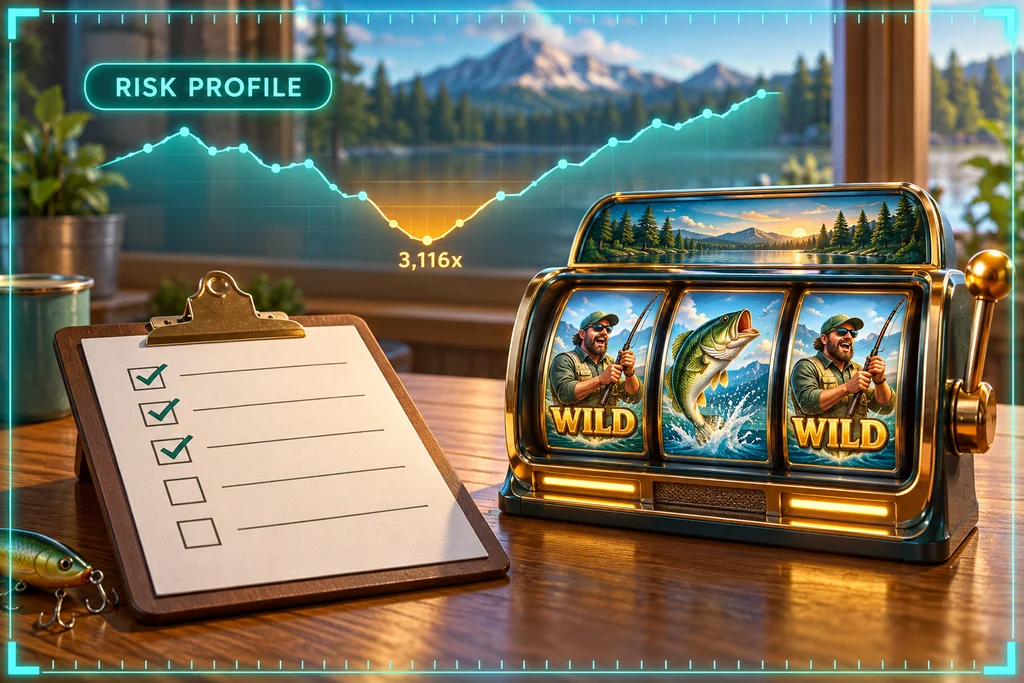
The worst case in the record is set out plainly. Replaying both runs back to back at one bet size, the review measures a deepest drawdown of 3,116x the stake, reached in run one by spin 9284, and a lowest point 2,243 stakes below the starting balance. Taken together, the series closed 1,965 stakes down. A single round matters here as well: if round 4497 is set aside, the remaining 19,999 rounds come out at 87.57%, so even the pooled figure leans on one feature.
The quieter signals are worth listing too, because they are what a budget meets most often:
- 56 spins: the longest run without a single win;
- 7.34 spins: the average dry spell between wins;
- 134 empty stretches of twenty spins or more across 20,000 rounds;
- 8,592 and 8,670 blank rounds in the first and second run;
- three waits for the feature longer than 600 spins, the longest 955.
None of this is unusual for a game that keeps most of its value in free spins. It simply means the reserve has to be sized for the slow stretches, not for the average.
Why plan for a range rather than a single figure?
Because the two sessions behind the pooled number behaved very differently, and either could resemble the next one. The first climbed to USD 101,746 on round 2590, then gave ground for most of the session until it touched USD 95,513.40 at round 9284, and closed at USD 96,628. The second went 1,074.5 stakes into profit by spin 4540, returned most of that and finished 279 stakes below its start, at USD 99,442.
The intervals differ as well: the first run's band reaches from 66.3% to 99.9%, the second run's from 77.0% to 117.4%, and their deepest drawdowns were 3,116x and 1,411x. Even the bought tickets followed the same split, averaging 0.59x of their price in the first session and 0.69x in the second. A plan that only works if the better session repeats is not much of a plan. Sizing the reserve for the pattern of the first session, and treating the second as a pleasant surprise, is the more cautious reading of the same record.
How long did a fixed bankroll last in Big Bass Splash?
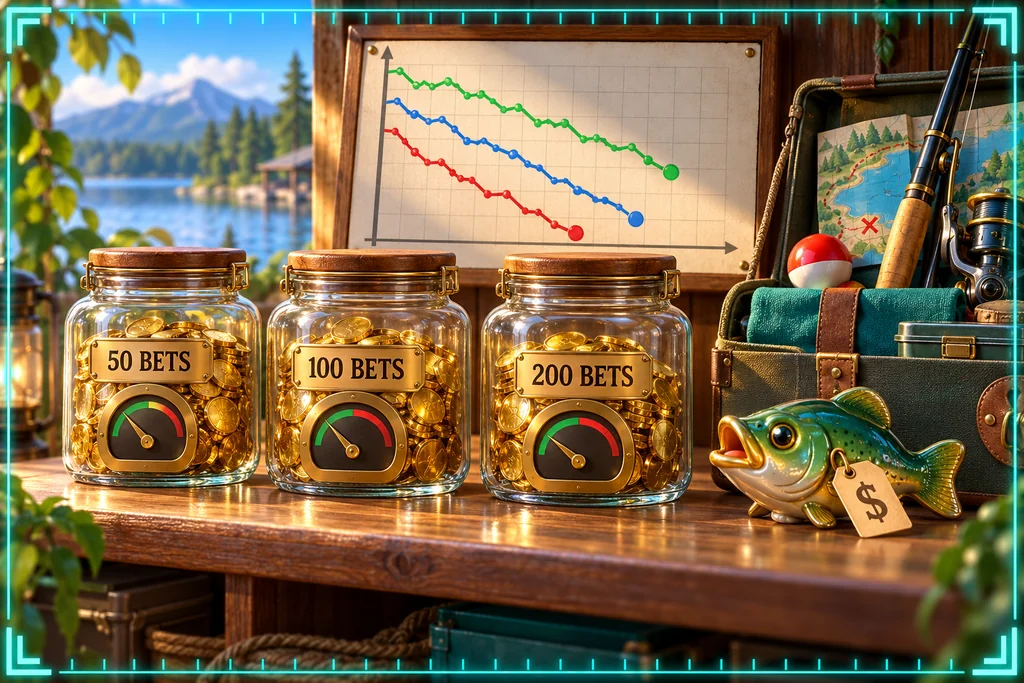
At the small end, not long. With the two runs played in sequence, a bankroll of 50 bets was exhausted at spin 71, one of 100 bets at spin 4851 and one of 200 bets at spin 5054. Inside the second run alone, the same three budgets lasted 65, 119 and 399 spins.
| Bankroll | Both runs in sequence: used up at spin | Run 2 on its own: spins it lasted |
|---|
| 50 bets | 71 | 65 |
| 100 bets | 4851 | 119 |
| 200 bets | 5054 | 399 |
Two lessons sit in that table. A larger reserve does not buy time in a neat, proportional way, because the timing of features decides more than the size of the pot: in the combined series the 100-bet and 200-bet budgets ran out at spins 4851 and 5054, close together. And the review itself notes that another session could run out sooner or not at all, so these lines are a recorded illustration rather than a law.
Why do the waits for the feature matter so much?
Because the feature carries the game. Bonus rounds produced 62.9% of the total return of Big Bass Splash: 170 natural features in 20,000 rounds, one per 118 spins on average, which averaged 66.73x the stake, with half of them paying 38.95x or less. In run one the first trigger came at spin 72; in run two it took until spin 150.
Between features the base game pays small amounts often, one hit in about 7.3 spins at a 1.00x median, and a single spin without scatters, out of 20,000, went past 100x: 200.5x, paid on round 5798 of the second session. A budget built around the average gap of 118 spins will sometimes meet a gap of 955, so planning for the long gap is the sensible default. That longest wait began at round 8490 of the second session and ended at round 9446.
Once a feature does arrive, its length varies. The average natural feature lasted 13.8 spins; 44 of the 170 retriggered, and two ran for forty spins: one paid 269.6x, the other 522.6x, the largest round in the record and far below the 5,000x cap.
Does the 100x bonus buy shorten the wait at a fair price?
It removes the wait, but on this record it costs more than it returns. 100 tickets at USD 200 each meant USD 20,000 spent and USD 12,808.40 returned, a net shortfall of USD 7,191.60, the value of 36 tickets. The average ticket gave back 0.64x, 78 of 100 finished below price, 22 broke even or better and five reached twice the price.
The spread is wide. The best ticket, purchase 49 of run one, paid USD 1,100, the worst returned 0.02x, and the buy return carries an approximate 95% band of 49% to 80%. In reserve-planning terms a purchase is a large, uneven draw on the budget that only now and then returns its cost, and it brings the same feature the scatters bring, averaging 13.5 spins.
The pattern held in both runs. In the first, 41 of 50 tickets came back under their cost; in the second, 37 of 50. Bought rounds retriggered 22 times in 100, close to the natural rate, so the ticket buys timing rather than a richer round.
Which questions does the Big Bass Splash review on slotester.com settle?
- How deep was the worst fall in the balance? The risk profile gives 3,116x the stake, reached in run one by spin 9284.
- When did small bankrolls run out? It lists spin 71 for 50 bets, spin 4851 for 100 and spin 5054 for 200, with the runs played in sequence.
- What return did the sample produce? The page shows 90.18% over 20,000 rounds beside the declared 96.71% and an approximate 95% band.
- Which dates are behind that figure? Two sessions are listed, 10 September 2026 at 83.14% and 29 September 2026 at 97.21%.
- How long can a spell without wins be? The test card gives 56 spins as the longest.
- How regularly does the feature arrive? It counts one natural trigger per 118 rounds, with three waits beyond 600 spins.
- How much of the return depends on bonus rounds? The verdict puts their share at 62.9%.
- What does a bought feature give back? The buy ledger shows USD 12,808.40 returned from USD 20,000 spent on 100 tickets.
- What is the largest round on record? It names 522.6x the stake, logged on round 4497 of the second run.
- Can the data be checked independently? Each run's files are downloadable, and each carries its own SHA-256 checksum.
- Is there a way to try the game without risk? A free browser demo on virtual credits, with no registration, is part of the page.
How does Big Bass Splash compare across Pragmatic Play?
Below the studio average on return, near the top on feature frequency. Slotester Lab publishes a studio overview at https://slotester.com/pragmatic-play-slots/ that gathers all 77 of its Pragmatic Play tests up to 20 October 2026, listing each game's measured RTP next to its declared one, along with a studio mean of 96.9% against 96.41%, the value of bought features (0.93x of the price on average) and the natural bonus rate, which in the median game is one trigger per 292 rounds.
In that table Big Bass Splash ranks 66th of 77 by measured RTP, and its 0.64x buy average trails the studio's figure. Its feature, by contrast, arrives faster than in most of the catalogue: just three studio titles start their feature more often. Across the studio, 38 tests landed above the printed RTP and 39 below it, a useful reminder that a single game's position is a reading of its own sample. For anyone planning a session, the trigger rate matters as much as the rank, because it sets how long a budget waits between the rounds that pay most.
Checking the record and trying the demo
Every run of Big Bass Splash keeps a readable spin log, a CSV with one row per round and the server's raw journal, each published with a SHA-256 checksum, and both runs were played against the provider's official demo server, with every request and response recorded. A copy downloaded today can be checked against its checksum, and the RTP of a run can be recalculated from the CSV with a short script.
The procedure behind those files is the same for every game the lab publishes. Software connects to the provider's demo build and writes down every server round: stake, win, each free spin and the closing collect. Pictures and video are recorded in their own browser session and never enter the numbers; an editor then checks the draft figure by figure against the log. Across the lab that routine has so far produced 163 tests, built on 2,820,000 ordinary rounds in 282 runs plus 10,200 bonus buys.
For a calm first look, the review includes a free demo of the game. It opens in the browser with no registration and uses virtual credits, which makes it a safe place to see how the dynamite, the bazooka and the collecting fisherman behave before deciding whether the game deserves any further attention.

A personal plan before any session
Slots are for adults only, 18+. The habits that make any plan work apply here as well: settle on a money limit and a time limit in advance, write them down if that helps, and stop when either is reached. The demo is the place to learn Big Bass Splash without spending anything. A measured 90.18% is a description of past rounds, not a promise for future ones, and a slot belongs in the entertainment budget, never in the income column. Short sessions with planned breaks help, and so does a simple rule against chasing: a loss is the price of entertainment already enjoyed, not a debt to win back. If play stops feeling like a free choice, stepping away is the right move.

Big Bass Splash RTP 2026: Bankroll Stress Test, 90.18% Measured and a 3,116x Drawdown
Good preparedness plans are written for the difficult week rather than the average one. The Big Bass Splash RTP review on Slotester treats a slot in a similar spirit: next to the measured return of the Pragmatic Play game and its declared figure, it sets out a risk profile of how much bankroll the logged sessions needed, and it offers a free demo of the game.
The headline takes one sentence. Over 20,000 recorded rounds Big Bass Splash returned 90.18% of stakes, while its rules declare 96.71%. The more useful part of the review is what happened on the way there: how far the balance fell, how long the quiet spells lasted and how soon a fixed budget was used up.
Everything in this article reflects the page as of 20 October 2026. The lab retests games and re-pools every figure when a new run arrives, so the risk profile can change as the sample grows.
What is Big Bass Splash, in plain terms?
It is a medium-volatility fishing slot from Pragmatic Play, launched in 2022 and built on five reels and three rows with ten fixed lines. Big Bass Splash declares an RTP of 96.71%, limits a single round to 5,000x the stake and sells its bonus for 100x. Most of the return arrives in free spins, where a fisherman wild collects the cash values printed on fish symbols.
Three scatters give ten free spins, four give fifteen, five give twenty. Up to five random modifiers may be attached before the feature starts, and every four fishermen collected raise the level and add ten spins, so later collections are worth 2x, 3x and finally 10x. Stakes on the official build range from USD 0.10 to USD 250, while in ordinary play the truck, the top line symbol, is worth 200x for five. The structure matters for planning: the base game pays little and often, and the larger payments wait inside the feature.
How firm is the 90.18% measured RTP of Big Bass Splash?
The measured RTP on Slotester is 90.18% across two runs of 10,000 rounds each, a session on 10 September 2026 that returned 83.14% and another on 29 September 2026 that returned 97.21%, both with a fixed USD 2.00 stake on the provider's official demo server. The approximate 95% interval spans 77.04% to 103.31% and includes the declared 96.71%. It describes those 20,000 rounds, not the next session. Pooling the two runs narrows the band compared with either session alone, and further runs should narrow it more, although one very large round can widen it again.
The width of that band is the honest part of the figure. A gap of this size between measured and declared is what chance produces in samples like these, so the site reads it as variance rather than as a sign of an altered game. Casinos are not bound to repeat the lab's numbers, and Pragmatic Play games often ship in several RTP versions, so an operator may run a lower one; which version is in use is printed in the game's own help pages at that operator.
Planning for the lean stretch: the risk profile
The worst case in the record is set out plainly. Replaying both runs back to back at one bet size, the review measures a deepest drawdown of 3,116x the stake, reached in run one by spin 9284, and a lowest point 2,243 stakes below the starting balance. Taken together, the series closed 1,965 stakes down. A single round matters here as well: if round 4497 is set aside, the remaining 19,999 rounds come out at 87.57%, so even the pooled figure leans on one feature.
The quieter signals are worth listing too, because they are what a budget meets most often:
None of this is unusual for a game that keeps most of its value in free spins. It simply means the reserve has to be sized for the slow stretches, not for the average.
Why plan for a range rather than a single figure?
Because the two sessions behind the pooled number behaved very differently, and either could resemble the next one. The first climbed to USD 101,746 on round 2590, then gave ground for most of the session until it touched USD 95,513.40 at round 9284, and closed at USD 96,628. The second went 1,074.5 stakes into profit by spin 4540, returned most of that and finished 279 stakes below its start, at USD 99,442.
The intervals differ as well: the first run's band reaches from 66.3% to 99.9%, the second run's from 77.0% to 117.4%, and their deepest drawdowns were 3,116x and 1,411x. Even the bought tickets followed the same split, averaging 0.59x of their price in the first session and 0.69x in the second. A plan that only works if the better session repeats is not much of a plan. Sizing the reserve for the pattern of the first session, and treating the second as a pleasant surprise, is the more cautious reading of the same record.
How long did a fixed bankroll last in Big Bass Splash?
At the small end, not long. With the two runs played in sequence, a bankroll of 50 bets was exhausted at spin 71, one of 100 bets at spin 4851 and one of 200 bets at spin 5054. Inside the second run alone, the same three budgets lasted 65, 119 and 399 spins.
Two lessons sit in that table. A larger reserve does not buy time in a neat, proportional way, because the timing of features decides more than the size of the pot: in the combined series the 100-bet and 200-bet budgets ran out at spins 4851 and 5054, close together. And the review itself notes that another session could run out sooner or not at all, so these lines are a recorded illustration rather than a law.
Why do the waits for the feature matter so much?
Because the feature carries the game. Bonus rounds produced 62.9% of the total return of Big Bass Splash: 170 natural features in 20,000 rounds, one per 118 spins on average, which averaged 66.73x the stake, with half of them paying 38.95x or less. In run one the first trigger came at spin 72; in run two it took until spin 150.
Between features the base game pays small amounts often, one hit in about 7.3 spins at a 1.00x median, and a single spin without scatters, out of 20,000, went past 100x: 200.5x, paid on round 5798 of the second session. A budget built around the average gap of 118 spins will sometimes meet a gap of 955, so planning for the long gap is the sensible default. That longest wait began at round 8490 of the second session and ended at round 9446.
Once a feature does arrive, its length varies. The average natural feature lasted 13.8 spins; 44 of the 170 retriggered, and two ran for forty spins: one paid 269.6x, the other 522.6x, the largest round in the record and far below the 5,000x cap.
Does the 100x bonus buy shorten the wait at a fair price?
It removes the wait, but on this record it costs more than it returns. 100 tickets at USD 200 each meant USD 20,000 spent and USD 12,808.40 returned, a net shortfall of USD 7,191.60, the value of 36 tickets. The average ticket gave back 0.64x, 78 of 100 finished below price, 22 broke even or better and five reached twice the price.
The spread is wide. The best ticket, purchase 49 of run one, paid USD 1,100, the worst returned 0.02x, and the buy return carries an approximate 95% band of 49% to 80%. In reserve-planning terms a purchase is a large, uneven draw on the budget that only now and then returns its cost, and it brings the same feature the scatters bring, averaging 13.5 spins.
The pattern held in both runs. In the first, 41 of 50 tickets came back under their cost; in the second, 37 of 50. Bought rounds retriggered 22 times in 100, close to the natural rate, so the ticket buys timing rather than a richer round.
Which questions does the Big Bass Splash review on slotester.com settle?
How does Big Bass Splash compare across Pragmatic Play?
Below the studio average on return, near the top on feature frequency. Slotester Lab publishes a studio overview at https://slotester.com/pragmatic-play-slots/ that gathers all 77 of its Pragmatic Play tests up to 20 October 2026, listing each game's measured RTP next to its declared one, along with a studio mean of 96.9% against 96.41%, the value of bought features (0.93x of the price on average) and the natural bonus rate, which in the median game is one trigger per 292 rounds.
In that table Big Bass Splash ranks 66th of 77 by measured RTP, and its 0.64x buy average trails the studio's figure. Its feature, by contrast, arrives faster than in most of the catalogue: just three studio titles start their feature more often. Across the studio, 38 tests landed above the printed RTP and 39 below it, a useful reminder that a single game's position is a reading of its own sample. For anyone planning a session, the trigger rate matters as much as the rank, because it sets how long a budget waits between the rounds that pay most.
Checking the record and trying the demo
Every run of Big Bass Splash keeps a readable spin log, a CSV with one row per round and the server's raw journal, each published with a SHA-256 checksum, and both runs were played against the provider's official demo server, with every request and response recorded. A copy downloaded today can be checked against its checksum, and the RTP of a run can be recalculated from the CSV with a short script.
The procedure behind those files is the same for every game the lab publishes. Software connects to the provider's demo build and writes down every server round: stake, win, each free spin and the closing collect. Pictures and video are recorded in their own browser session and never enter the numbers; an editor then checks the draft figure by figure against the log. Across the lab that routine has so far produced 163 tests, built on 2,820,000 ordinary rounds in 282 runs plus 10,200 bonus buys.
For a calm first look, the review includes a free demo of the game. It opens in the browser with no registration and uses virtual credits, which makes it a safe place to see how the dynamite, the bazooka and the collecting fisherman behave before deciding whether the game deserves any further attention.
A personal plan before any session
Slots are for adults only, 18+. The habits that make any plan work apply here as well: settle on a money limit and a time limit in advance, write them down if that helps, and stop when either is reached. The demo is the place to learn Big Bass Splash without spending anything. A measured 90.18% is a description of past rounds, not a promise for future ones, and a slot belongs in the entertainment budget, never in the income column. Short sessions with planned breaks help, and so does a simple rule against chasing: a loss is the price of entertainment already enjoyed, not a debt to win back. If play stops feeling like a free choice, stepping away is the right move.